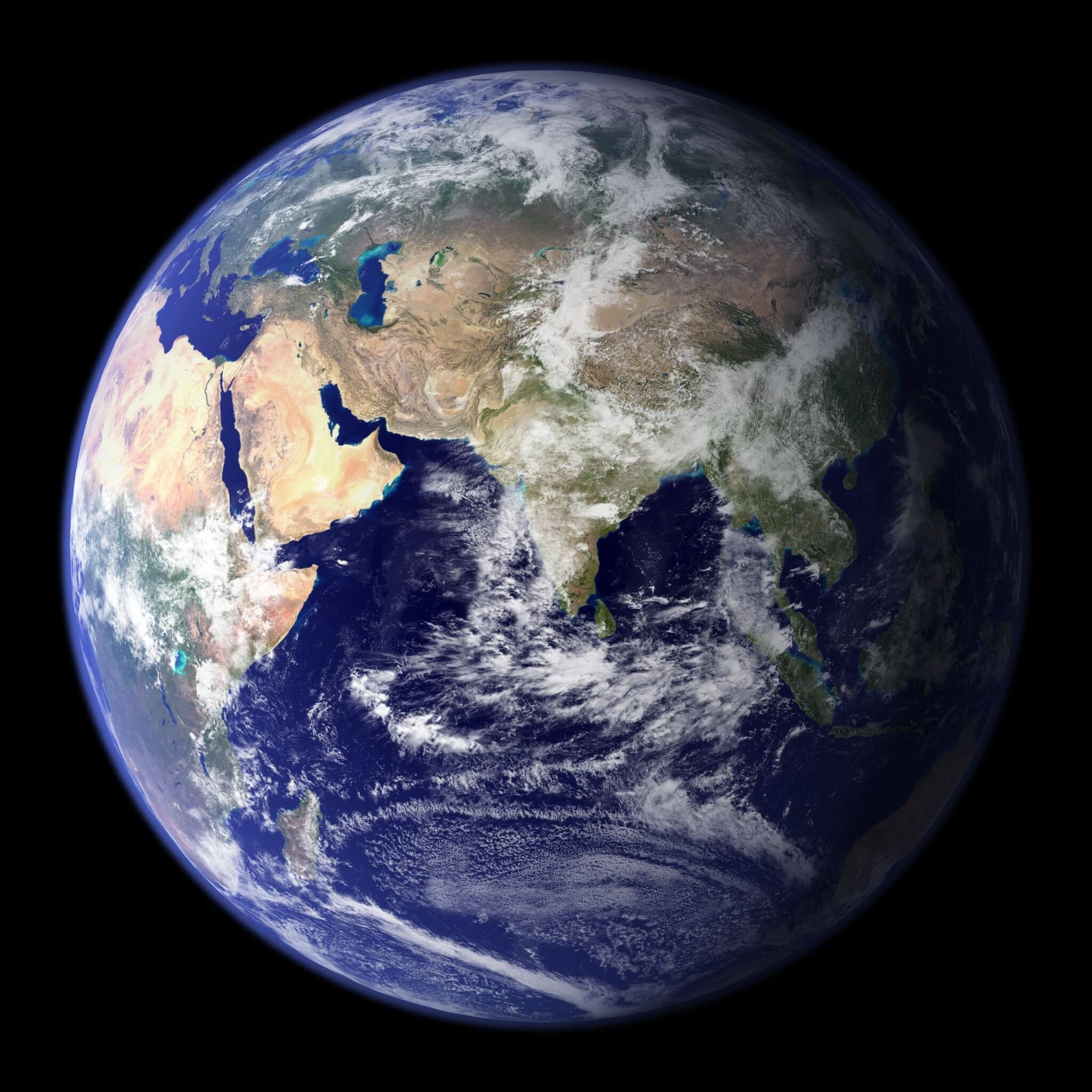
The Earth
The Earth is the third planet from the sun and the only known planet that is capable of supporting life. It has a diameter of about 12,742 kilometers (7,918 miles) and a mass of approximately 5.97 x 10^24 kilograms.
The Earth's orbit around the sun takes approximately 365.25 days to complete, which is why we have a leap year every four years to adjust for the extra quarter day. The Earth's rotation on its axis causes day and night and takes approximately 24 hours to complete.
Overall, the Earth is a unique and remarkable planet that provides a home for millions of species, including humans, and it is essential that humans take care of it to ensure its continued health and prosperity.
Is The Earth Round Or Flat?
The Earth is round, or more precisely, it is an oblate spheroid shape. This means that it is roughly spherical in shape, but it bulges at the equator and is slightly flattened at the poles. The evidence for the Earth's roundness has been known for thousands of years, and it has been observed and measured in various ways, including through photographs of the Earth from space.
The idea that the Earth is flat has been debunked numerous times throughout history, including by ancient Greek mathematicians, who used observations of the Earth's shadow during lunar eclipses to demonstrate that it must be round. In modern times, scientific evidence such as satellite images, global positioning systems (GPS), and the ability to circumnavigate the Earth by traveling in a straight line have all confirmed the Earth's roundness.
Despite overwhelming scientific evidence, there are still some people who believe that the Earth is flat, and this has led to a resurgence of flat Earth conspiracy theories in recent years. However, these beliefs are not supported by any scientific evidence and are widely rejected by the scientific community.
Proof That The Earth Is Round
There is a wide range of scientific evidence that demonstrates that the Earth is round, including:
If The Earth Is round, Why Don't People And Objects Fall Off At The Other End?
People and objects do not fall off the Earth because of the force of gravity. Gravity is the force that attracts objects with mass towards each other, and it is what keeps us and everything else on the Earth's surface.
Gravity is caused by the mass of the Earth and is strongest at the surface. It pulls objects towards the center of the Earth, which keeps us firmly planted on the ground. The strength of the gravitational force decreases with distance from the Earth's surface, which is why objects that are farther away from the Earth are not pulled as strongly.
The Earth's round shape also plays a role in gravity. The Earth's mass is distributed evenly around its spherical shape, which means that the gravitational force is consistent across the surface. This is why objects do not roll off the sides of the Earth or accumulate at the poles.
In summary, the force of gravity is what keeps people and objects on
the Earth's surface, and the Earth's round shape helps to distribute
this force evenly across the surface.
Despite overwhelming scientific evidence, there are still some people
who believe that the Earth is flat, and this has led to a resurgence
of flat Earth conspiracy theories in recent years. However, these beliefs
are not supported by any scientific evidence and are widely rejected by the
scientific community.

